
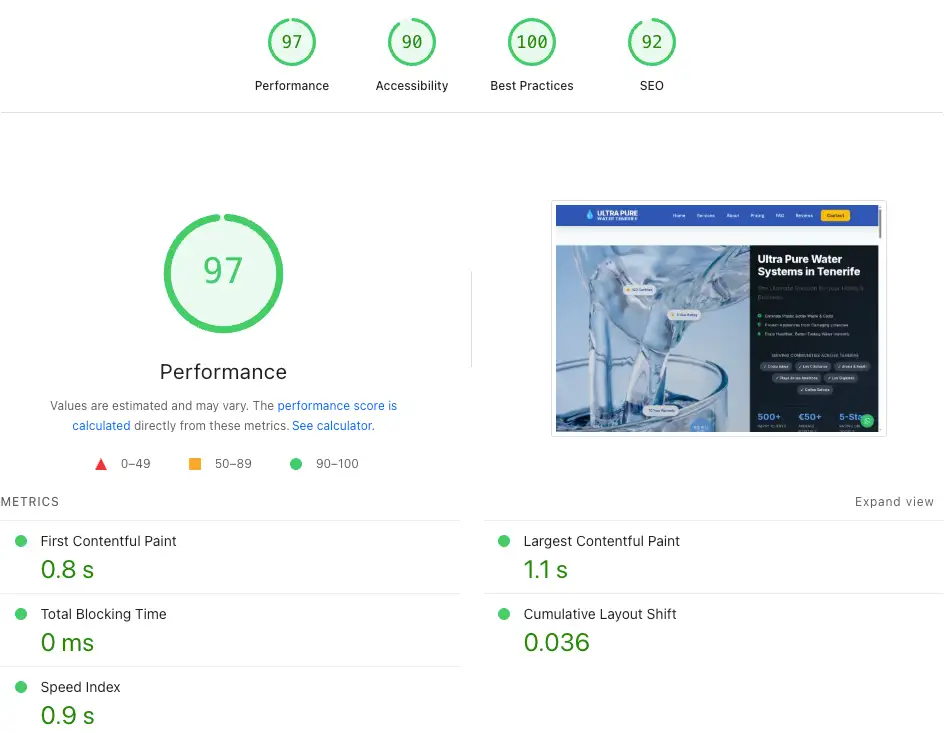
You can target the right keywords perfectly and still lose to a competitor with a worse business, purely because their site loads faster than yours. Speed isn't a technical nice-to-have here — it's a direct SEO ranking factor, and on Tenerife specifically, it's also the single biggest reason mobile visitors abandon a site before they ever see your phone number.
Core Web Vitals: Google's Actual Speed Test
Google scores every site against a set of metrics called Core Web Vitals: how fast the main content appears, how quickly the page responds to a tap, and whether elements jump around while loading. These aren't abstract developer metrics — they feed directly into where you rank, particularly on mobile.
Most local business sites in Tenerife fail these tests, usually because they're built on WordPress with heavy page-builder plugins, uncompressed photos straight from a phone camera, and shared hosting that struggles under load in high season.
The "Beach Connection" Problem
This matters more here than in most markets. Picture your customer: sitting on a beach in Costa Adeje, or in a café in Puerto de la Cruz, on patchy 4G because the local network is saturated with tourists doing the same thing. They tap your Google result. If they're staring at a blank white screen four seconds later while a heavy theme loads its plugins, they're gone — back to the results page, straight to your competitor.
The Data Doesn't Lie
Google's own research shows that 53% of mobile visits are abandoned if a page takes longer than 3 seconds to load. That's roughly half your potential customers gone before they ever see your phone number or WhatsApp button — and it happens more often here, not less, because of exactly the network conditions above.
How We Hit a 99/100 Performance Score
We rebuilt our own site to prove the point: a 99/100 Google PageSpeed score on mobile, putting it in the top 1% of sites globally. The approach isn't exotic — it's the same discipline we apply to every client site:
1. No WordPress Bloat
Pure, hand-coded static HTML with no database, no plugin stack, no page-builder JavaScript fighting for the main thread. There's nothing to load that isn't actually needed on the page.
2. Next-Gen, Mobile-Sized Images
WebP images sized specifically for the device requesting them — not a 4MB camera photo scaled down in the browser. Visually identical, a fraction of the file size.
3. Asset Preloading and Minification
Critical assets are told to download first; everything else — extra whitespace, comments, unused code — gets stripped so the browser has less to parse.
4. Instant First Paint
The result is a First Contentful Paint around 0.7 seconds — the visitor sees real content essentially the instant the page opens, even on a mediocre connection.
The Local SEO Payoff
When someone searches "plumber Costa Adeje," Google wants to serve a fast answer alongside a relevant one. A fast site is a direct signal of quality that helps you climb both organic results and the Google Maps pack — on top of simply converting more of the visitors you already earn.
If You're Paying for Traffic, Speed Is Where It Leaks Out
If you're running ads, boosting posts, or relying on word-of-mouth to send people to your site, a slow site is where that investment quietly disappears. Every visitor who bounces before the page loads is a customer you already paid to reach and lost anyway. Technical SEO like this is difficult to retrofit onto an existing WordPress site — which is exactly why we build it in from the start on every project, rather than treating it as an add-on. See exactly why we build on static HTML instead of WordPress for the full reasoning.
Want to know your actual score?
Send me your site and I'll run it through the same tools Google uses, then tell you honestly what's costing you visitors.
Get a Free Speed Test